LDL-C 너머: 동맥경화 위험을 보는 세 가지 시선 (Atherogenic Lipoprotein Markers)
LDL-C가 같아도 동맥경화 위험은 다를 수 있습니다. Cholesterol mass, particle number, particle identity를 통해 LDL-C 너머의 위험을 살펴봅니다.
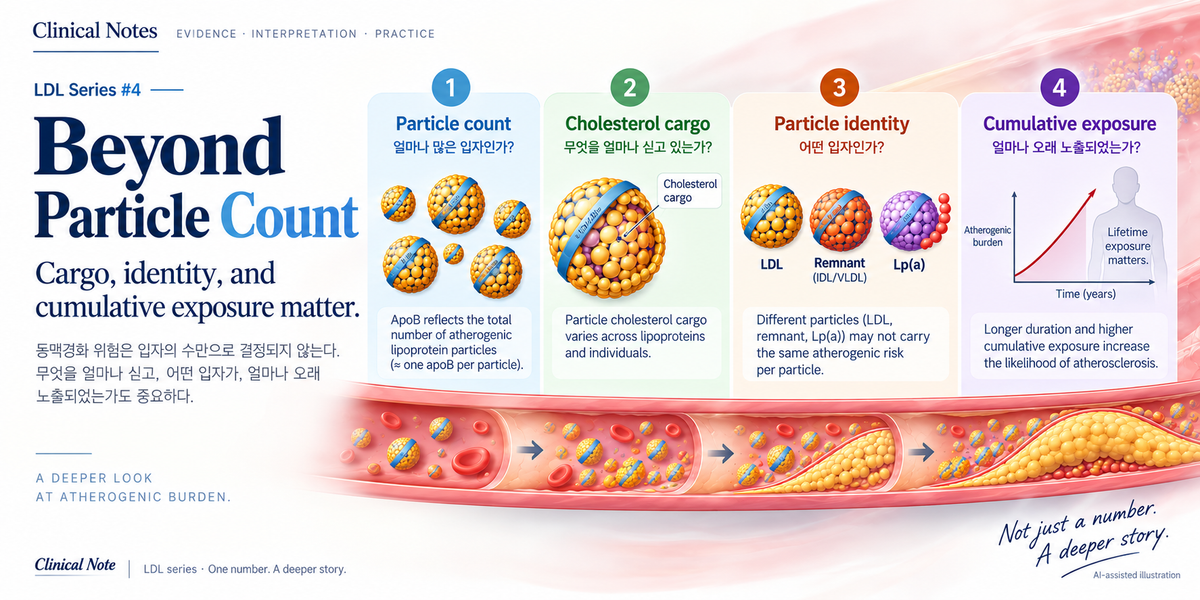
Three ways to see atherogenic burden
동맥경화 위험은 입자의 수만으로 결정되지 않는다. 무엇을 얼마나 싣고, 어떤 입자가, 얼마나 오래 노출되었는가도 중요하다.
Key Question | LDL-C가 목표에 도달했다면, atherogenic lipoprotein burden도 충분히 낮아졌다고 말할 수 있을까?
1. Three measurements, different questions
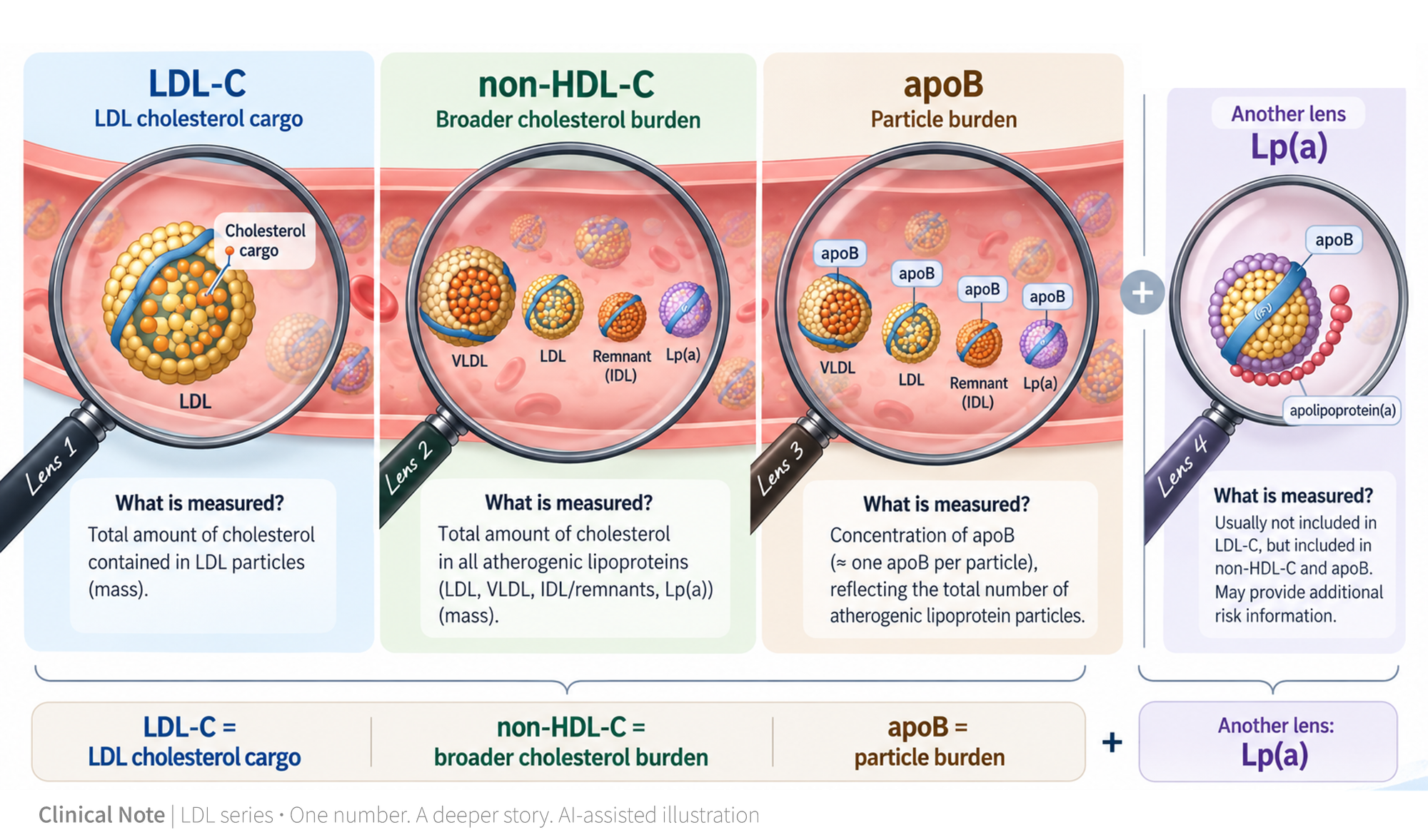
LDL-C는 LDL fraction에 포함된 콜레스테롤 총량(mass)을 나타낸다.
Non-HDL-C (= total cholesterol − HDL-C)는 LDL뿐 아니라 VLDL, IDL/remnants, Lp(a)에 실린 콜레스테롤까지 포함한다.
ApoB는 atherogenic lipoprotein particle에 대체로 하나씩 존재하는 apoB 분자의 농도를 측정하여 총 particle concentration을 반영한다. 단, LDL, remnant, Lp(a)가 각각 얼마나 존재하는지는 구분하지 못한다.
Figure 1 | Three views of the same blood: LDL-C, non-HDL-C, apoB.
대부분의 환자에서는 이 세 가지 지표가 함께 움직인다.
LDL이 혈중 apoB-containing particles의 대부분을 차지하고,
cholesterol mass와 particle number가 서로 연관되기 때문이다.
LDL-C가 중요한 치료 목표로 남아 있는 이유다.
그러나 세 지표가 서로 어긋나는 순간, 하나의 숫자로 설명되지 않는 정보가 드러난다.
2. Why do cholesterol mass and particle number disagree?
Insulin resistance, diabetes, obesity, hypertriglyceridemia에서는 hepatic VLDL1-TG production 및 apoB100 secretion이 증가할 수 있다.
이때 CETP-mediated lipid exchange를 통해 LDL은 TG-enriched, cholesteryl ester-depleted 상태가 되고,
이후 hepatic lipase에 의한 TG 및 phospholipid hydrolysis를 거쳐 작고 cholesterol-depleted한 LDL phenotype (small dense LDL, sdLDL)으로 remodeling될 수 있다.
sdLDL은 한동안 중요한 atherogenic phenotype으로 주목받았지만,
현재 sdLDL particle size나 sdLDL-C를 별도로 측정하여 임상적 의사결정에 활용할 근거는 충분하지 않다.
sdLDL과 ASCVD의 연관성은 높은 apoB particle burden 및 동반된 대사 이상과 상당 부분 겹친다.
한편, 세 지표의 discordance가 모두 생물학적 이유로 나타나는 것은 아니다.
TG가 높거나 LDL-C가 낮은 상황에서는 Friedewald, Martin/Hopkins, Sampson 등 LDL-C 추정식의 차이 또는 direct LDL-C assay의 측정 특성에 따른 불일치일 수도 있다.
따라서 biological discordance로 해석하기 전에 각 숫자와 측정 방법을 점검해야 한다.
Before calling it biological discordance, check whether it is measurement discordance.
3. ApoB or non-HDL-C — is there a winner?
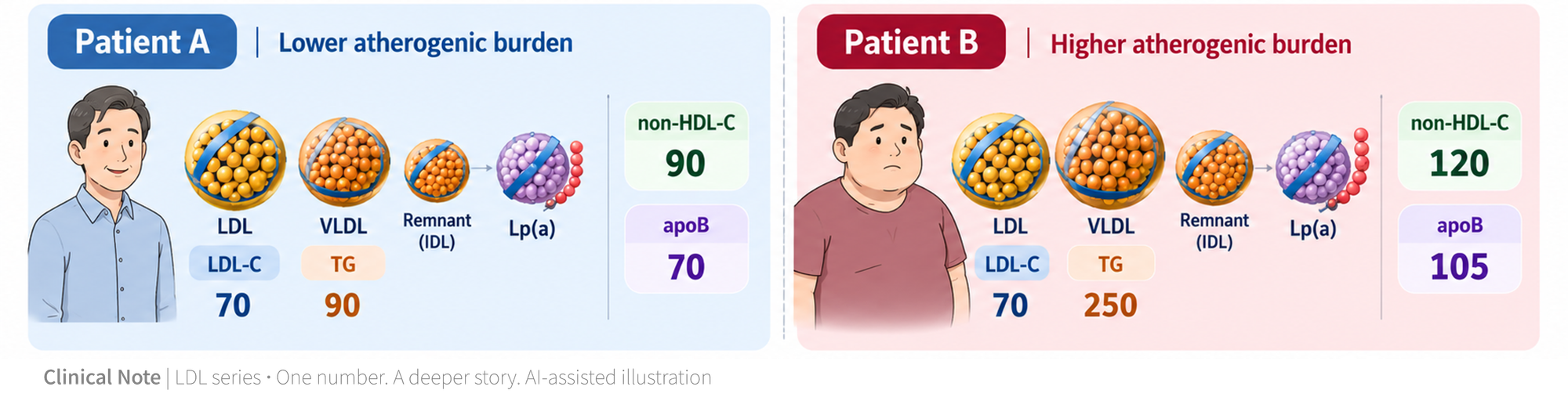
두 환자의 LDL-C는 같지만, B에서는 cholesterol burden과 particle burden이 더 높다.
Figure 2 | Same LDL-C, different burden
그렇다면 LDL-C 말고 apoB, non-HDL-C를 측정해야 하나?
apoB를 알아도 non-HDL-C가 도움이 될까?
어떤 연구에서는 apoB가 다른 lipid measures를 보정한 후에도 MI와 연관되는 반면 cholesterol content의 추가적인 독립 연관성은 명확하지 않았다. [1]
반대로 cholesterol mass의 역할을 강조하는 genetic analysis도 있다.[2]
연구 설계, population, lipoprotein composition, outcome이 달라 이 결과를 단순한 승패로 읽을 수 없다.
지질저하제를 복용하지 않는 Copenhagen General Population Study 94,398명에서 high apoB/low non-HDL-C와 high non-HDL-C/low apoB가 모두 concordant-low군보다 높은 위험과 연관됨을 보였지만, 상호 보정한 ASCVD HR (per 1 SD)은 non-HDL-C 1.11 (95% CI 1.05–1.18), apoB 1.05 (0.99–1.10)였다.[3]
ASCVD C-statistic은 기존 모델 0.7592, non-HDL-C 추가 0.7623, apoB 추가 0.7622, 둘 다 추가 0.7624였지만, 이 결과만으로 cholesterol cargo 자체의 인과효과를 확정할 수 없다.
Statistical association, causal contribution, incremental clinical discrimination은 서로 다른 질문이기 때문이다.
즉,
apoB만으로 끝내지 마라—non-HDL-C도 별도의 risk information이 있다.
4. Beyond apoB: Particle identity — are all atherogenic particles equally harmful?
콜레스테롤은 plaque에 축적되는 물질이다.
apoB-containing particles는 이를 동맥벽으로 운반하며 retention될 수 있는 구조인데,
apoB100은 proteoglycan binding에도 관여하므로 단순한 수동적 운반체는 아니다.
ApoB particle number는 동맥벽에 접근할 기회를,
particle cholesterol cargo는 retention된 입자가 전달할 수 있는 lipid burden을 반영할 가능성이 있다.
같은 apoB 농도라도
LDL, remnant, Lp(a)의 상대적 구성과 입자당 cholesterol cargo는 달라질 수 있다.
즉, apoB는 입자의 총수를 알려주지만 어떤 입자가 얼마나 존재하는지는 알려주지 않는다.
이 차이가 바로 particle identity의 문제다.
모든 apoB-containing particle이 동일한 atherogenic contribution을 갖는다고 가정할 이유는 없다. 그렇다고 “작을수록 위험하다”는 단순한 순위도 성립하지 않는다.
Same apoB does not necessarily mean the same risk. Particle identity may matter.

최근 LDL, remnant, Lp(a)의 per-particle ASCVD risk가 같지 않을 수 있다는 주장이 주목받고 있다. [4]
역학 및 유전 연구에서는 remnant와 Lp(a)의 입자당 ASCVD 위험 연관성이 LDL보다 클 수 있다는 결과가 제시되었다.
다만 이를 입자별로 고정된 인과적 위험 가중치로 해석하기는 아직 어렵다.
반면 LDL은 압도적인 입자 수와 누적 노출 때문에 전체 위험에 크게 기여한다.
여기서 두 종류의 지표를 구분하면 이해가 쉬워진다.
LDL-C와 remnant-C는 특정 cholesterol fraction을, Lp(a) 측정은 특정 lipoprotein population을 들여다보는 individual measurements이고,
non-HDL-C와 apoB는 여러 population의 cholesterol mass 또는 particle count를 통합하는 integrated measurements다.
어느 쪽이 더 우수하다는 뜻이 아니라, 서로 다른 질문에 답한다는 의미다.
Figure 3 | Beyond particle count: cargo, identity, and cumulative exposure
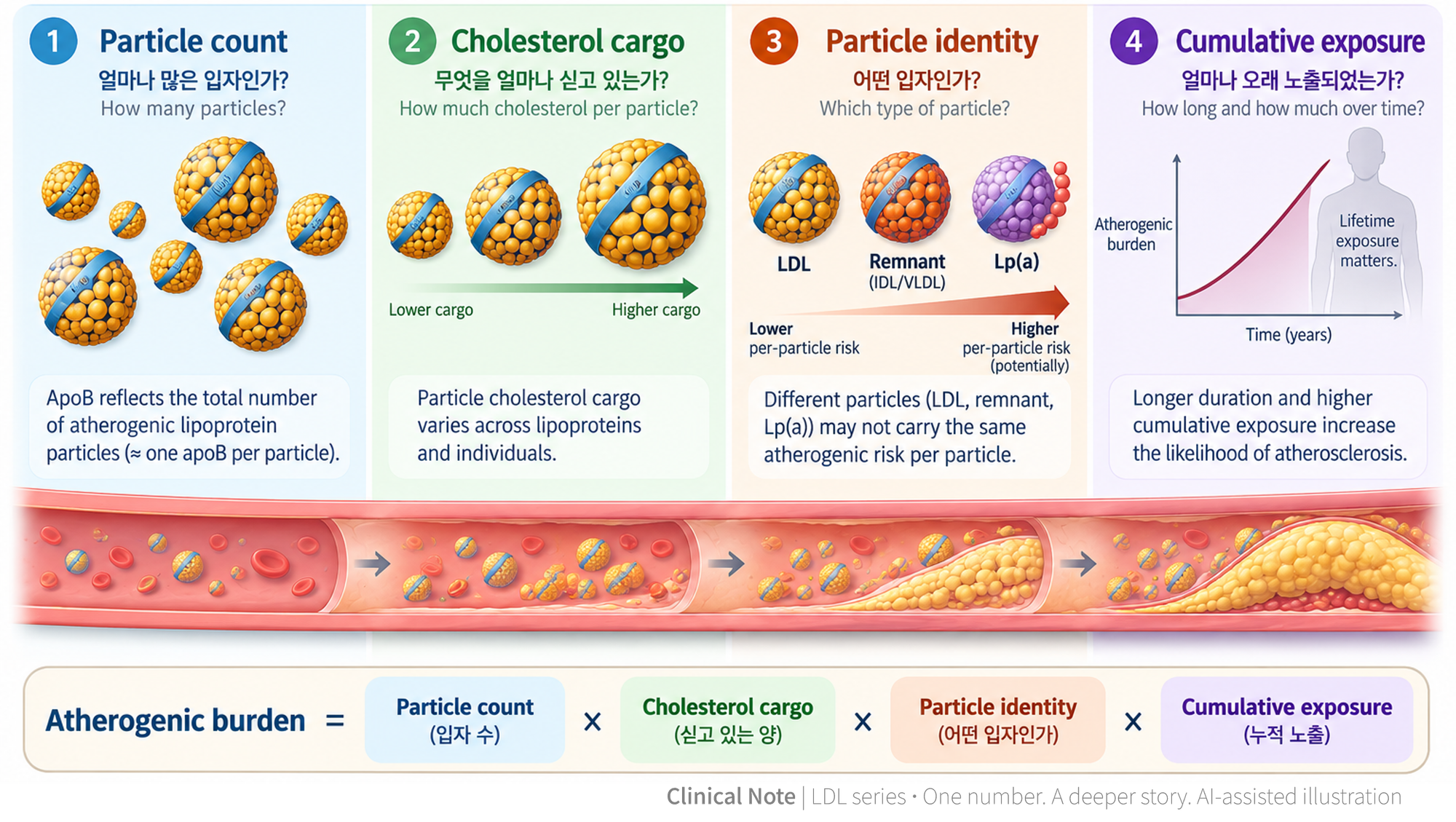
따라서 “같은 apoB에서 cholesterol cargo가 많은 입자가 더 위험한가?”라는 질문은 아직 완결되지 않았다.
입자 크기뿐 아니라 arterial entry, retention, composition, residence time 및 exposure duration이 함께 중요할 수 있다.
Atherogenic burden is more than particle count: cargo, identity, and cumulative exposure matter.
5. What can the clinician actually do?
LDL-C는 여전히 우선적인 치료 지표다.
Non-HDL-C는 별도 비용 없이 TG-rich lipoprotein cholesterol까지 포함하는 넓은 시야를 제공한다.
ApoB는 TG elevation, insulin resistance/diabetes, 치료 후 매우 낮은 LDL-C 등에서 cholesterol concentration과 particle number의 불일치를 확인하는 데 도움이 될 수 있다.
검사 선택은 환자의 위험도, guideline, 접근성, 결과가 실제 치료 결정을 바꾸는지에 따라 판단해야 한다.
또한, Non-HDL-C와 apoB가 모두 낮더라도 Lp(a)에 특이적인 위험을 배제할 수는 없다.
두 지표는 Lp(a)의 농도와 입자 특성을 구분해 주지 않기 때문이다.
→ Lp(a)를 별도로 측정해야 하는 이유는 다음 편에서 자세히 다룬다.
LDL-C, remnant-C, Lp(a)의 개별 평가는 유용한 개념적 틀이지만,
이들 지표의 위험 연관성과 특정 표적을 낮추는 치료의 outcome evidence는 구분해야 한다.
특히 remnant 또는 Lp(a)를 선택적으로 낮추는 전략의 ASCVD outcome 근거는 아직 확립 정도가 다르다.
Clinical takeaway
- LDL-C, non-HDL-C, and apoB are not interchangeable. Cholesterol mass tells us how much cholesterol is carried, while apoB reflects how many atherogenic particles are circulating. Both provide complementary information, but neither fully describes particle identity.
- Same apoB does not necessarily mean the same risk. LDL, remnants, and Lp(a) may differ in their atherogenic contribution per particle. Particle number matters, but cholesterol cargo, particle identity, and cumulative exposure may also shape ASCVD risk.
- Discordance is information, not automatically an indication for more testing. The goal is not to measure everything, but to understand what each measurement adds to clinical decision-making.
References
- Marston NA, et al. Association of Apolipoprotein B-Containing Lipoproteins and Risk of Myocardial Infarction. JAMA Cardiol 2022;7:250–256. doi: 10.1001/jamacardio.2021.5083.
- Björnson E, et al. Lipoprotein(a) is markedly more atherogenic than LDL: an apolipoprotein B-based genetic analysis. J Am Coll Cardiol 2024;83:385–395.
- Johannesen CDL, et al. Non-HDL Cholesterol and Apolipoprotein B Measures and Risk of ASCVD. JAMA Cardiol 2026;11:669–673. doi: 10.1001/jamacardio.2026.0898.
- Nordestgaard BG, Hegele RA. Residual lipid risk in atherosclerotic cardiovascular disease. Eur Heart J 2026;47:3347–3365. doi: 10.1093/eurheartj/ehag087.
- Johannesen CDL, et al. Discordance analyses comparing LDL cholesterol, non-HDL cholesterol, and apolipoprotein B. Atherosclerosis 2025;403:119139.
- Björnson E, et al. Triglyceride-rich lipoprotein remnants, LDL, and risk of coronary heart disease. Eur Heart J 2023;44:4186–4195.
- Björnson E, et al. Quantifying triglyceride-rich lipoprotein atherogenicity. J Am Coll Cardiol 2024;84:1328–1338.